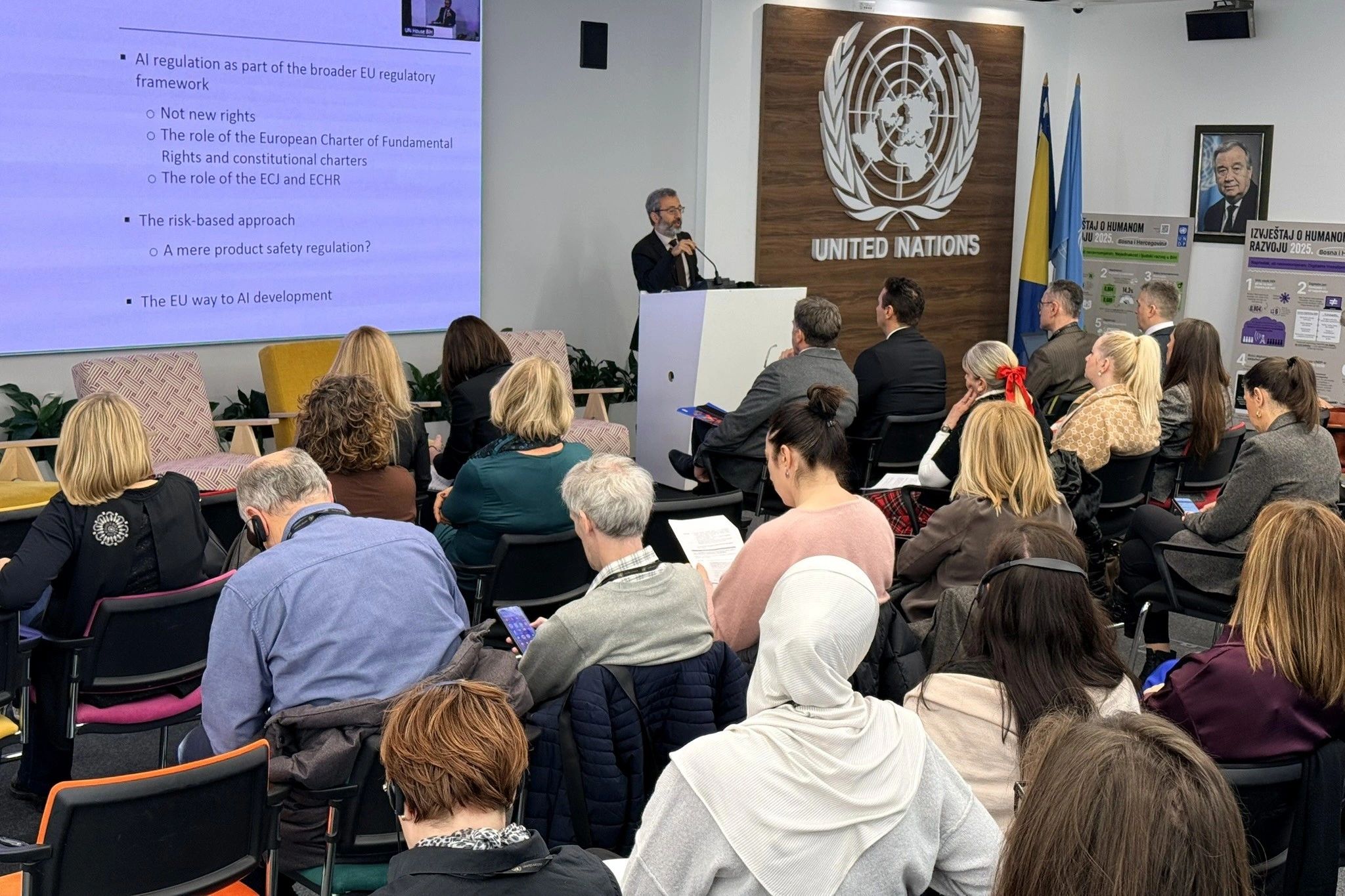
On 26 and 27 Novenbere, the Ministry of Human Rights and Refugees of Bosnia and Herzegovina, the Ministry of Communications and Transport of Bosnia and Herzegovina, the United Nations Development Programme (UNDP), and the Office of the United Nations High Commissioner for Human Rights (OHCHR), with the support of Organization for Security and Co-operation in Europe (OSCE), organised a two-day conference to reflect on the impact of digital technologies, including AI, on human rights, and to identify ways to ensure a human rights based approach to the regulation, design, deployment, use and management of AI.
The conference focused on human rights–based approaches to digital technologies and AI. Over two days, participants analysed challenges and opportunities, exchanged practical experiences, unpacked relevant international human rights standards, and identified concrete steps to foster a human rights-based approach to AI and other digital technologies, both by the public and private sectors.
On the second day, the focus was on presenting and discussing Human Rights Impact Assessment (HRIA) methodology as a tool for institutions and companies developing AI technologies in the coming years. The HRIA methodology for AI, developed by Prof. Mantelero for the UNDP, was applied to concrete cases in a learning exercise involving representatives of private and public entities.
Building on the success of previous workshops in Turkey and Georgia, this workshop in Sarajevo provided another valuable opportunity to demonstrate how human-centred AI can be designed in various contexts and countries by placing human rights at the core of the innovation process.
For more information on this UNDP event, please visit: